With ongoing enrollment pressures, economic uncertainty, and rapidly evolving technology within higher education, digital marketing can no longer operate on autopilot.
In 2026, successful higher ed digital marketing strategies will be defined less by channel-specific tactics and more by trust, value, and adaptability across the entire digital ecosystem. Three focus areas are shaping higher ed digital marketing in 2026, and institutions should take note to stay competitive and credible.
Social Proof and Reputation: Enrollment Marketing
Social media is no longer just a promotional channel for schools; it has evolved into another search engine, making social proof across all corners of marketing that much more prevalent. Prospective students are actively researching institutions through TikTok, Instagram, Reddit, and YouTube, gathering information and experiences to form their own opinions long before they ever land on your institution’s website.
As a result, the top of the enrollment funnel is no longer driven by awareness alone, but paired with trust in reputation. Students expect your school’s brand story to be validated by authentic social proof across all digital spaces.
In 2026, we’ll see a shift to belief before inquiry. If students can’t easily envision themselves fitting in academically and socially at your institution, they won’t bother to take the next step. They aren’t looking for perfection during their college search; they’re looking for a school that aligns with how they envision their ideal college experience. They want to see real students, experiences, and outcomes that mirror that vision, allowing them to truly believe that they will thrive at your school.
Higher education marketing should prioritize:
- User-generated content & showcasing student voices
- Transparent storytelling that reflects campus culture
- Consistent brand messaging across social platforms, search, & third-party sites
This integrated enrollment marketing approach reinforces reputation and builds trust through social proof long before an admissions form is submitted.
Demonstrating Value: Showing Return on Investment
Economic volatility and the current employment climate has made students and families increasingly skeptical of a degree’s ROI, and rightfully so.
According to the U.S. Census Bureau and U.S. Bureau of Labor Statistics, the unemployment rate for recent college graduates is at a high of 4.8 percent as of June 2025. Schools can no longer rely on reputation, legacy, or prestige alone to speak for them. They must actively demonstrate the value of an education under their institution and clearly communicate return on investment.
This means going beyond generic outcomes and showing tangible proof, including:
- Post-graduation employment data
- Alumni success stories tied to specific programs
- Internship pipelines, employer partnerships, & networking opportunities
- Unique program features that differentiate your institution
Demonstrating ROI isn’t about overselling, it’s about reassurance. Students want to feel confident that their investment of time, money, and effort will lead to meaningful opportunities on campus and post-grad. Marketing strategies that combine data storytelling with human outcomes will translate and resonate most strongly.
AI’s Reach: Visibility Across the Digital Space
While AI itself isn’t new, the way it’s being used and the reach of its effects are rapidly shifting. These shifts must be taken into account when marketing in 2026.
Search Engine Optimization to “Search Everywhere Optimization”
With social platforms acting as search engines and the rise of AI-generated overviews reshaping how information is delivered, success in higher education digital marketing will no longer be measured by search rankings alone.
While a strong search engine optimization foundation still matters, visibility now additionally means providing the embedded answer when a prospective student asks a question, no matter where that question is asked.
Search Engine Optimization is shifting to “Search Everywhere Optimization,” a coin termed by Ashley Liddell of Deviation. SEO is still what it has always been, it’s just expanding.
Institutions must optimize content for discovery across:
- Traditional search engines
- Social media platforms
- AI-generated summaries & recommendations
Content strategies should focus on clarity, authority, and relevance. “Search everywhere” does not mean “everyone, everywhere” in a literal sense. Your digital content shouldn’t be spread thin, it should be strategic in targeting your audience in their online pockets of the internet. The goal is not just traffic, but trust, ensuring your institution is recognized as a reliable source wherever students are searching.
AI Automation and Personalization: Finding a Balance
AI usage in marketing is accelerating by the day, and while the automation of tedious tasks builds efficiency, it’s vital to have discernment when integrating AI into your marketing. Automation offers saved time, scalability, and helpful insights, but unchecked use risks stripping authenticity from the student experience.
The institutions that succeed in 2026 will be those that find a balance between AI-driven efficiency with human-centered communication. Knowing when to apply AI-powered content optimization and when authentic, human delivery is most valuable will make a world of difference.
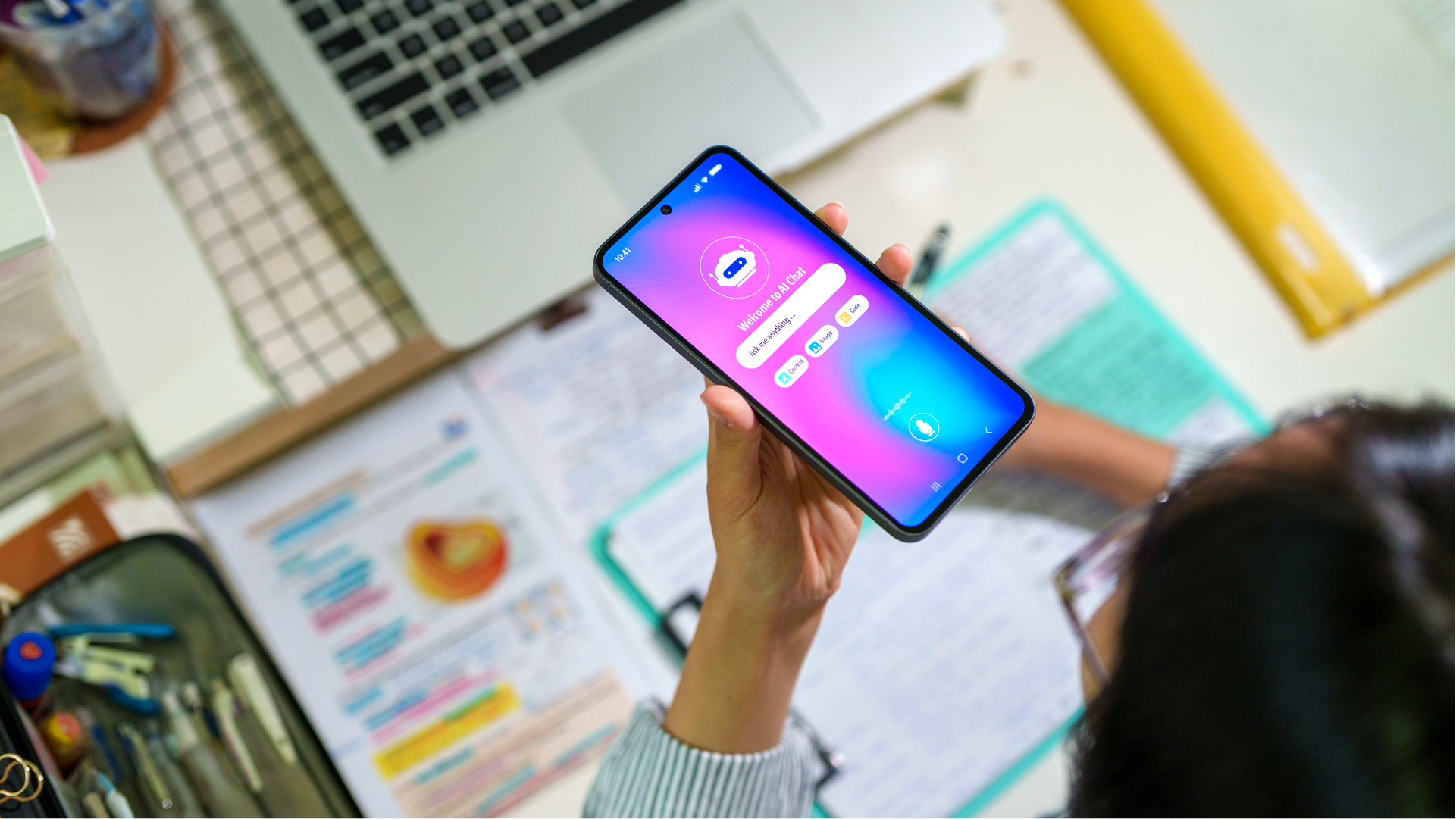
Chatbots, for example, are now essential to the college search process, making the student journey much more self-directed. However, their effectiveness coincides with the personalization of these AI tools, making the experience for your target audience unique to their needs. In the case of chatbots, this would mean adapting to individual interests, academic goals, and prospective student behaviors, all while still reflecting your institution’s voice and values.
Use AI tools to:
- Automate repetitive tasks & data analysis
- Personalize content & communication journeys
- Support, not replace, human connection that defines school values & culture
Discernment will be key here. Technology should enhance trust, not erode it.
Preparing for 2026
Higher education digital marketing in 2026 will demand an integrated marketing strategy that prioritizes reputation, proves value, and adapts to an increasingly AI-driven digital landscape.
We’re already seeing the shift surrounding social proof in the college search, the need for understanding ROI with traditional degrees, and AI’s effects on marketing. 2026 will only increase the pace of these changes. Institutions that embrace transparency, authenticity, and adaptability will be best positioned to connect with today’s students.